
Bonvo Ski
Bonvo Ski: Precision Downhill Physics & Alpine Slalom Mastery on Nate Hand Gesture
Welcome to the cutting edge of browser-based winter sports engineering. Bonvo Ski on Nate Hand Gesture delivers an authentic, physics-driven alpine descent simulation that translates complex downhill kinematics into an exhilarating, highly technical gaming experience. Far from a simplistic click-and-glide arcade diversion, Bonvo Ski models realistic slope gradients, variable snow friction coefficients, centrifugal cornering forces, and rotational inertia across iconic alpine terrain profiles. Available with zero installation requirements and instant web browser execution, the simulation challenges discerning players to master precise input timings and shave crucial split-seconds off demanding mountain time trials.
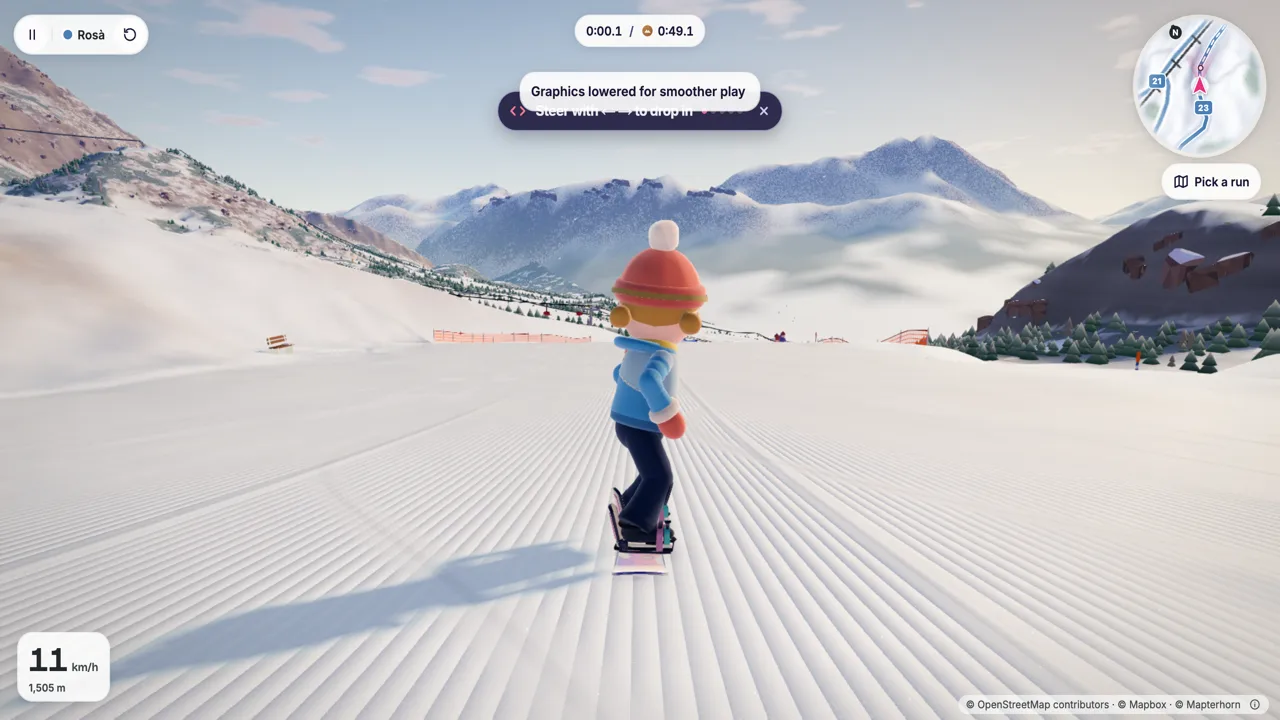
From the rarefied atmosphere of the 1,505-meter starting gate down through challenging off-camber transitions and high-speed compression dips, every single meter of slope demands technical vigilance and razor-sharp reaction fidelity.
Downhill Kinematics: Gravitational Acceleration & Snow Friction Profiles
Understanding the mathematical forces governing your descent in Bonvo Ski is essential for consistent podium finishes:
- Gravitational Fall-Line Vectors: Your velocity vector accelerates most aggressively when aligned directly down the steepest fall line. Angling away from the fall line bleeds potential energy into lateral displacement, stabilizing speed but increasing transit time.
- Dynamic Edge Bite & Friction: Carving engages steel edges into packed snow. Gentle steering maintains laminar flow, whereas sharp, abrupt steering transitions induce lateral drift friction that scrubs up to 12 km/h off your current velocity profile.
- Surface Texture Transition Zones: Groomed corduroy tracks exhibit minimal surface resistance, allowing sustained speeds in excess of 35 km/h. Veering outside safety markers into deep uncompressed powder increases rolling friction, requiring deliberate forward skating inputs to maintain cadence.
- Centrifugal Load Balancing: When negotiating high-speed parabolic turns at speeds exceeding 30 km/h, lateral g-forces attempt to push your rider toward outer perimeter netting. Countering this centrifugal displacement demands deliberate early apex positioning along the interior turn radius.
Telemetry Analysis & Real-Time Course Instrumentation
Bonvo Ski equips competitive racers with comprehensive real-time telemetry displayed non-intrusively across the heads-up display:
- Digital Velocity & Altimeter Gauge (Bottom Left): Monitors instantaneous velocity in km/h alongside barometric elevation in meters, allowing players to evaluate acceleration rates through varying slope pitches.
- Split Timer & Target Comparison (Top Center): Tracks elapsed run time down to the tenth of a second against predetermined sector par benchmarks, highlighting whether current splits are tracking ahead or behind record pace.
- Polar Course Radar & Checkpoint Tracker (Top Right): Displays an active 360-degree course orientation dial that plots upcoming gate markers (Nodes 21 and 23), lift cable infrastructure, and critical course bifurcations.
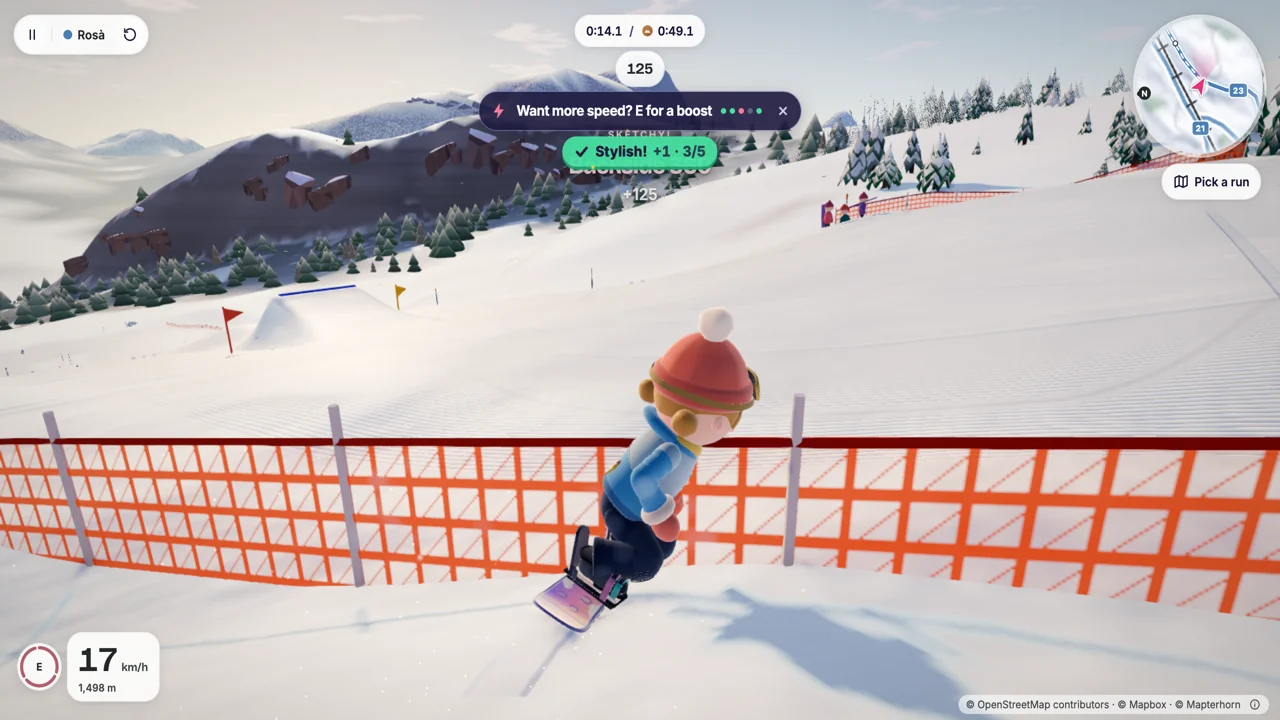
- Kinetic Energy Boost Reservoir (Lower Left Meter): Accumulates stored kinetic potential generated from flawless trick executions and high-speed compression rebounds, ready to be discharged via keypress.
Advanced Input Mechanics: Carving, Jump Timing & Aerial Aerodynamics
Executing flawless runs requires an intimate mastery of the game's responsive input mappings:
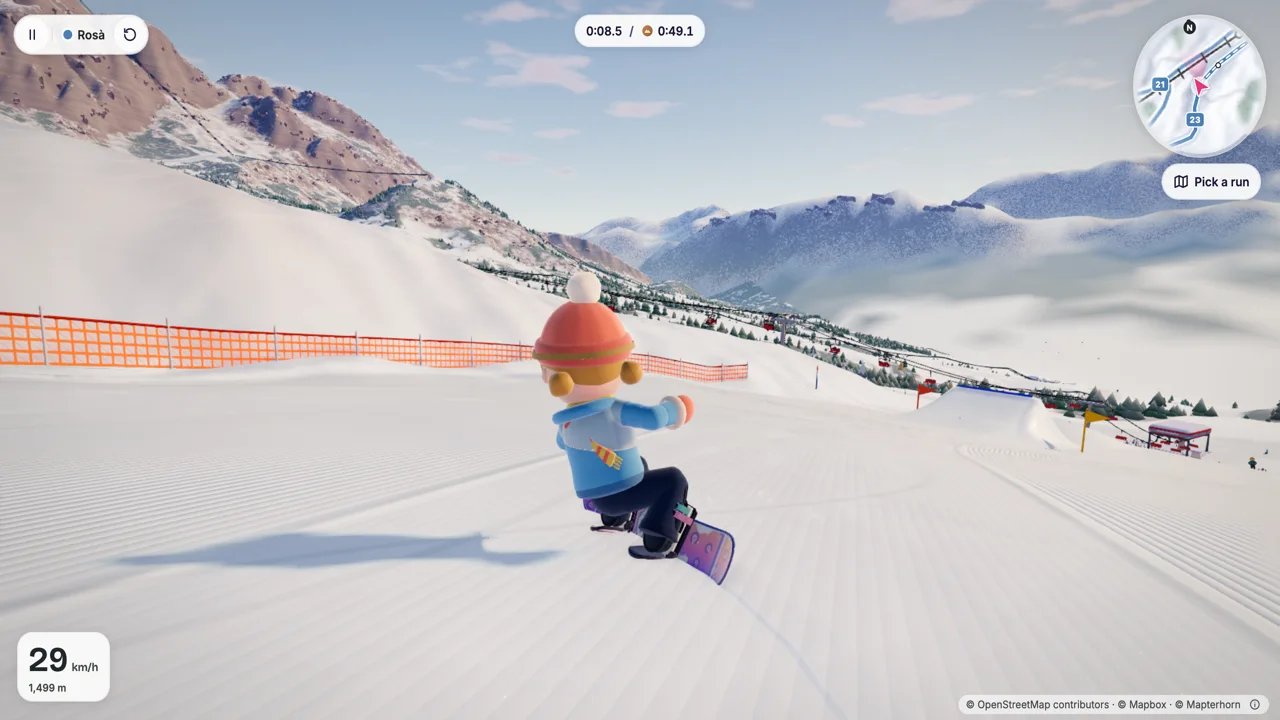
- Slalom Steering & Edge Articulation: Utilize `Left Arrow` (`A`) and `Right Arrow` (`D`) for micro-adjustments and deep carving arcs. Pulsing the input produces tight radius adjustments without inducing friction stalls.
- Vertical Takeoff Modulation: Press `Spacebar` at the exact lip threshold of terrain kickers. Launching late clips the ramp shoulder and destabilizes trajectory, while launching early curtails maximum vertical parabolic arc.
- In-Flight Angular Momentum: While airborne, depress `Up Arrow` (`W`) for pitch-forward front rotations or `Down Arrow` (`S`) for pitch-backward aerial maneuvers. Releasing rotational commands milliseconds prior to ground impact aligns landing gear with surface camber.
- Pneumatic Nitro Boost: Depress `E` to discharge accumulated boost potential during low-gradient transition zones to overcome flat terrain inertia.
- Dynamic Recovery Stance: When stalled on flat plateaus, depress `Up Arrow` (`W`) to execute rhythmic skate strides, or hit `R` to instantly reinitialize the sector drop-in.
- Rotational Landing Alignment: Hitting snow with your board perpendicular to forward velocity causes a severe traction penalty and instant speed dump. Always counter-steer in mid-air to ensure board axis coincides precisely with the downward slope vector.
Terrain Geometry & Section-by-Section Course Breakdown
Mastering the premier Cortina d'Ampezzo mountain run requires dissecting its primary structural segments:
1. The Summit Launch Shute (1,505m – 1,480m): A steep, straight drop ideal for accumulating early kinetic momentum. Avoid early steering inputs; align your board directly down the center track to breach 25 km/h within 4 seconds.
2. The High-Alpine S-Chicane (1,480m – 1,450m): Two consecutive 45-degree sweeps framed by orange boundary netting. Apply progressive left bank angle, apex early, and transition smoothly into the opposing right-hand berm.
3. The Compression Roller & Kicker Zone (1,450m – 1,400m): An undulating terrain park featuring calibrated snow ramps. Calculate approach velocity carefully: launching at 30 km/h delivers optimal hang-time for stylish 360-degree spins.
4. The Tree-Lined Plateau Traverse (1,400m – 1,350m): Gradient flattens considerably. Discharge stored boost energy immediately upon touchdown to prevent velocity decay below 20 km/h.
5. The Final High-Speed Schuss (1,350m – Valley Base): Wide, uninterrupted straightaway leading to the timing gates. Maintain minimal lateral oscillation and cross the beam to establish top leaderboard status.
Speed Optimization Strategies & Time Trial Tactics
Competitive time trial specialists utilize these advanced tactical doctrines to consistently break sector records:
- Apex Clipping: Minimize total distance traveled by shaving gate boundaries as tightly as geometry permits without triggering boundary deceleration.
- Airtime Conservation: In pure speed runs, excessive airtime can actually diminish acceleration, as gravity accelerates skiers faster along steep slopes than during freefall. Use micro-hops to absorb kickers rather than launching maximum parabolic arcs.
- Boost Sequencing: Reserve nitro discharges for uphill transitions or flat connecting shelves where gravitational assistance drops to zero.
- Aerodynamic Drag Reduction: Refrain from unnecessary aerial maneuvers when chasing pure stopwatch efficiency. Clean carving lines conserve up to 15% more kinetic energy than erratic trick jumping.
- Explore Technical Disciplines: After perfecting your racing lines in Bonvo Ski, broaden your tactical gaming repertoire across our curated racing and reflex libraries in the [New Games](/new-games) and [Hot Games](/hot-games) sectors on Nate Hand Gesture!
Technical Architecture, WebGL Rendering & Zero-Latency Performance
Built upon high-throughput WebGL and canvas rendering pipelines, Bonvo Ski delivers low-latency 60 FPS graphics across modern web environments, including Chrome, Safari, Firefox, and Edge. The engine employs lightweight asset bundling, adaptive LOD (Level of Detail) terrain streaming, and hardware-accelerated physics calculations to ensure instantaneous response times even on entry-level hardware and school Chromebooks. Experience frictionless alpine racing precision today on Nate Hand Gesture!